

Categories
Community Focus, Westchase / West Park Village, Tampa Market StatsPublished October 29, 2026
Renting vs. Buying in Westchase: The Real Math (and the One Thing That Flips It)

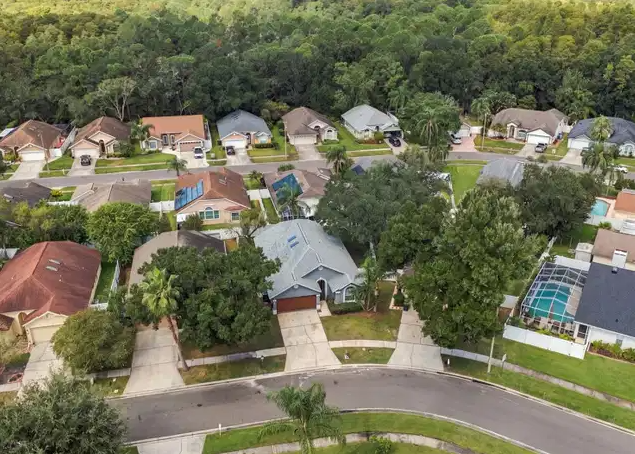
Renting in Westchase is not throwing your money away. That sounds strange coming from a real estate agent. But the numbers back it up, and you deserve to see them before you make the biggest financial decision of your life.
There's also one factor that flips the entire result. It isn't rent. It isn't buying. We'll get there.
Watch FULL VIDEO Here:
The setup: two identical Westchase homes
Most rent-vs-buy comparisons quietly stack the deck. This one doesn't. Picture two identical houses in Westchase: same square footage, same school zone, same HOA. Each costs $650,000. One family buys. The other rents for $3,400 a month.
The buyer puts 20% down ($130,000), plus closing costs, plus the Westchase Community Association capital contribution of $2,500 at closing. That's roughly $150,000 out of pocket on day one.
The renter puts down nothing. He invests that $150,000 instead. Every year, he also invests whatever he saves by renting rather than owning. That's the only way the comparison means anything.
The true monthly cost of owning
After the down payment, the mortgage is $520,000. At today's 30-year fixed rate of roughly 7.3% (per Freddie Mac), principal and interest come to about $3,572 a month.
A lot of people stop there. They compare $3,572 to $3,400 in rent and call it even. But that's not what the house actually costs.
|
Monthly cost |
Amount |
|---|---|
|
Principal and interest |
$3,572 |
|
Property taxes (~$6,500/yr) |
~$540 |
|
Homeowners insurance (~$5,500/yr) |
~$460 |
|
HOA and CDD |
~$200 |
|
Maintenance (1% of value/yr) |
~$540 |
|
True cost of owning |
~$5,300 |
That's about $1,900 a month more than rent, or roughly $23,000 a year the renter gets to invest.
"But my mortgage builds equity." True, partially. In year one, about $43,000 goes to mortgage payments. Only about $5,000 of it pays down principal. The rest is interest. So after 12 months, the owner built about $5,000 in equity. The renter invested $23,000.
Year 10: homeowner vs. renter
To keep this honest, the model uses long-term averages, not the unusual run of the last decade: 3.5% annual home appreciation, 8% average stock market return, and 3% annual rent increases.
|
Year 10 |
Homeowner |
Renter |
|---|---|---|
|
Asset value |
Home worth ~$917,000 |
$150K grows to ~$324,000 |
|
Offsets / additions |
Loan balance ~$450,000; ~$69,000 to sell (7.5%) |
Annual savings invested: ~$374,000 |
|
Net position |
~$398,000 |
~$698,000 |
A house isn't cash until you sell it, so the fair comparison uses net proceeds. At year 10, the renter is ahead by about $300,000.
Year 20: homeowner vs. renter
|
Year 20 |
Homeowner |
Renter |
|---|---|---|
|
Asset value |
Home worth ~$1.3 million |
$150K grows to ~$699,000 |
|
Offsets / additions |
Loan balance ~$300,000; ~$97,000 to sell |
Annual savings invested: ~$1.3 million |
|
Net position |
~$893,000 |
~$2 million |
Nearly $900,000 in Westchase home equity is a fantastic outcome. But the disciplined renter is ahead by about $1.1 million.
The assumption hiding in plain sight
Here's the catch. The renter's $2 million depends on investing the difference every single month for 20 years. When the market was up, he invested. When it dropped 20%, he invested. When the car turned 10 years old, he kept driving it and invested.
Would you actually do that, every month, for two decades, with nobody making you?
Run it again with the same renter, same $150,000 invested, same 20 years. This time he spends the monthly difference on a nicer car, better vacations, a bigger TV. He finishes at about $699,000. The homeowner finishes at about $893,000.
The homeowner wins by roughly $194,000.
Buying doesn't beat renting. Discipline beats both. A mortgage is forced savings with a really inconvenient delivery method.
And some things don't fit in a spreadsheet. When you own, nobody can raise your rent. Nobody can tell you to move in March because the owner wants to sell. You can paint the house any color you like (as long as the HOA signs off).
A quick word on taxes
Neither side was taxed in this model. The renter's investment gains would be taxed when sold. The homeowner gets the primary residence exclusion, but it has a ceiling: $250,000 for single filers and $500,000 for married couples filing jointly. Both sides will likely owe something. Talk to a CPA. Bryan is a Realtor, not a tax adviser.
How long do you need to stay for buying to make sense?
Buying costs you twice: once when you buy (closing costs plus the Westchase capital contribution) and again when you sell. Selling costs run bigger than most people expect: commissions, Florida doc stamps on the deed, owner's title insurance, and closing fees. Call it 7.5% to 8% all in, or roughly $50,000 on a $650,000 home.
Here's what that does on a short stay. Buy this house and sell in two years:
- At 3.5% appreciation, it's worth about $696,000
- The loan is paid down to about $510,000, leaving about $186,000 in equity
- Selling costs run about $52,000, more than the appreciation you earned
- You walk away with about $134,000
You put in $150,000. You walked out with $134,000. You lost about $16,000 on a house that went up in value. That's not opinion. That's arithmetic.
Zillow's national buy-vs-rent analysis puts the break-even at about six years, with a range from roughly four years to never, depending on the market. That estimate was modeled at a rate a bit above 6%. At today's rates, the clock runs longer. There's no Westchase-specific Zillow break-even number to share, so we won't invent one.
What we can do is run your numbers with real Westchase rents and prices. For context, $3,400 a month is a very good rent for a $650,000 home here.
The bottom line
If you're staying under three years, buying is a very expensive way to feel like an adult. If you're staying long-term and putting real money down, buying locks in your housing cost and builds equity whether you feel like saving or not.
If you rent and invest the difference every single month for 20 years, renting is not throwing your money away. What you can't do is rent, spend the difference, and call it a strategy. That's the only option that definitely loses.
Run your own numbers
Don't make a decision this size on anyone's rule of thumb, including ours. Grab the free spreadsheet linked in the video description. Change the home price, rent, rate, and appreciation, and see which side wins for you.
Thinking About Buying or Selling in Westchase?
Whether you're relocating to Tampa Bay or selling in Westchase or West Park Village, we know this neighborhood from the inside. Ask us about the HELP Program: we invest up to $50,000 in pre-listing improvements, and you pay nothing until closing. Ask about MOFIR too. Your price. Our promise.
🌐 Search homes + free resources: westchaserealtor.com
📱 Phone/Text: (727) 325-6009
📧 Email: bryan@bryancoward.com
🌐 Website: bryancoward.com
The Bryan Coward Team · Keller Williams Realty · Tampa Bay, FL · Each KW office independently owned and operated. Bryan Coward PA, Florida Licensed Real Estate Broker Associate. Market data reflects general trends and should not be construed as a formal appraisal or guaranteed valuation.

Bryan Coward
Realtor | The Bryan Coward Team | Bryan Coward | Keller Williams Realty
or another way